Bridging Scientific Innovation and Clinical Translation
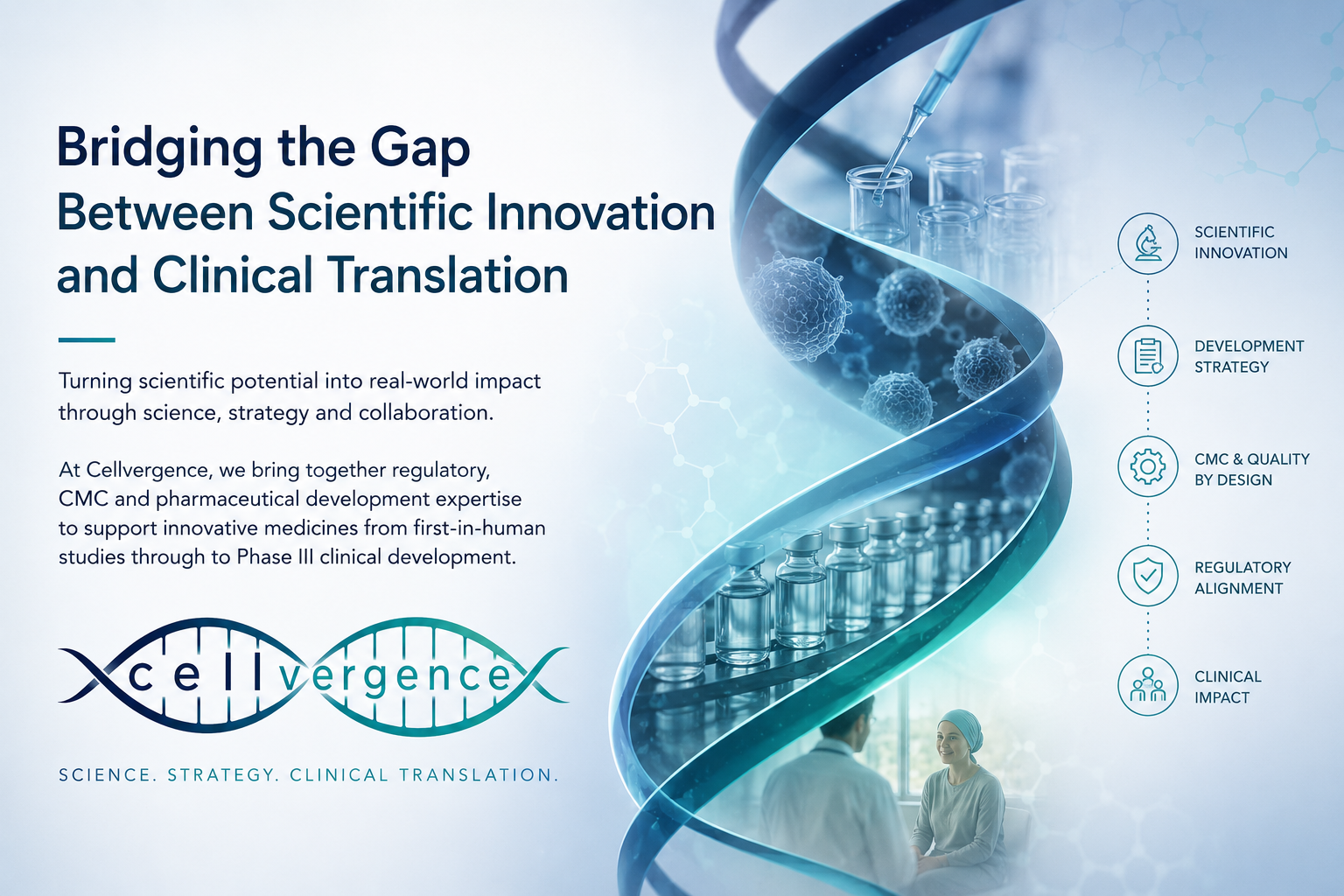
Bridging the Gap Between Scientific Innovation and Clinical Translation
Scientific innovation is moving at an extraordinary pace. Novel biological medicines, advanced therapies, new delivery technologies and increasingly complex approaches to treatment continue to create opportunities to address unmet clinical needs.
But generating promising science is only the beginning.
One of the greatest challenges in medicines development is translating scientific innovation into a product that can be manufactured consistently, meets appropriate quality standards, satisfies regulatory expectations and can ultimately be evaluated safely in patients.
This transition from scientific concept to clinical development is where regulatory strategy, pharmaceutical development and CMC become critical.
Good Science Does Not Automatically Make a Developable Medicine
Early development programmes often begin with a strong scientific rationale and encouraging preclinical data. However, the material used to generate those data may be very different from the medicinal product ultimately intended for clinical use.
Moving towards a clinical trial introduces a different set of questions.
Can the product be manufactured consistently?
What are its critical quality attributes?
Are the analytical methods appropriate for their intended purpose?
What specifications are required at this stage of development?
Is there sufficient stability data to support the proposed clinical trial?
Are the starting materials and manufacturing processes adequately controlled?
Can the manufacturing process operate within an appropriate GMP framework?
And, importantly, is the available quality package sufficient to support the proposed clinical development programme?
These questions are interconnected. Decisions made during early pharmaceutical development can have significant implications for manufacturing, regulatory submissions and subsequent clinical development.
The Importance of Phase-Appropriate Development
A common challenge in early medicines development is determining how much development is enough before entering the clinic.
The requirements for a first-in-human or early-phase investigational medicinal product should not necessarily be identical to those expected for a commercial product.
At the same time, “early phase” should not be interpreted as an absence of appropriate pharmaceutical controls.
The objective is to establish a development strategy that is scientifically justified, risk-based and appropriate to the stage of clinical development.
This may require carefully considering the maturity of analytical methods, specifications, process understanding, stability data and product characterisation.
The appropriate level of control will depend on several factors, including the nature of the product, its manufacturing process, the clinical population, route of administration and the risks associated with uncertainty in individual quality attributes.
A well-designed development programme therefore needs to balance two considerations: generating sufficient evidence to protect participants and support regulatory decision-making, while avoiding unnecessary development activities that do not meaningfully reduce risk at that stage.
Regulatory Strategy and CMC Should Develop Together
Regulatory strategy is sometimes considered separately from pharmaceutical development. In practice, the two are closely connected.
A regulatory pathway cannot be developed effectively without understanding the product and its manufacturing process. Equally, CMC development should consider the regulatory pathway and the clinical programme it is intended to support.
This becomes particularly important for innovative or complex medicinal products, where established development models may not always provide straightforward answers.
Early identification of potential regulatory and CMC challenges can allow development teams to address them proactively rather than discovering them during regulatory assessment or immediately before a clinical trial.
Where significant uncertainty exists, early engagement with regulatory authorities can also provide an opportunity to discuss the proposed development strategy and obtain feedback before substantial resources are committed.
Bringing the Right Expertise Together
Successful clinical translation rarely depends on a single discipline.
Scientists understand the biology and mechanism of the product. Manufacturing teams understand the process. Analytical scientists understand how the product can be characterised and controlled. Clinical teams understand the intended patient population and clinical environment. Quality professionals ensure that appropriate systems and controls are established.
Regulatory and pharmaceutical development strategy needs to bring these perspectives together.
The strongest development programmes are therefore often those where science, CMC, manufacturing, quality, regulatory and clinical considerations are addressed collectively rather than sequentially.
This multidisciplinary approach can help identify development risks earlier, establish clearer priorities and create a more coherent pathway towards clinical evaluation.
From Scientific Potential to Clinical Development
There is rarely a single template for translating an innovative medicine into the clinic.
Each product brings its own scientific uncertainties, manufacturing challenges and regulatory considerations. The development strategy therefore needs to reflect the characteristics of the product and the clinical programme rather than simply applying a standard checklist.
This philosophy is central to Cellvergence.
The name reflects the convergence of science, regulation and pharmaceutical development required to move innovative medicines towards clinical application.
Our approach is centred on providing science-led, pragmatic and proportionate support across regulatory strategy, CMC and pharmaceutical development, GMP and quality, and clinical development.
Ultimately, effective clinical translation is not simply about satisfying a regulatory requirement. It is about building a development programme in which the science, manufacturing process, quality controls, regulatory strategy and clinical objectives are aligned.
That alignment can make the difference between promising science remaining an experimental concept and progressing towards meaningful clinical evaluation.
Cellvergence provides specialist regulatory, CMC, pharmaceutical development and GxP support for organisations developing medicinal products.
Science. Strategy. Clinical Translation.